A cybersecurity risk assessment turns scattered signals into a clear, prioritized, actionable plan. For organizations balancing security, operations, and budget, the difference between a generic audit and a useful assessment is specificity: evidence that a problem exists, a business‑focused explanation of why it matters, and a remediation roadmap that shows who does what and when. Abel Solutions structures assessments to deliver exactly that: measurable posture improvements grounded in telemetry and mapped to business priorities.
What a Risk Assessment Is (And What It Isn’t)
A risk assessment is a structured, evidence‑driven review of your environment that weighs threats and vulnerabilities against their likelihood and potential business impact, connecting technical findings to business consequences. It’s not a one‑off vulnerability scan or a checklist of best practices. A cybersecurity risk assessment combines:
- Telemetry and configuration data from cloud and endpoint tools
- Interviews with technical and business owners to understand processes and priorities
- Analysis that maps technical weaknesses to business consequences, such as customer data exposure, operational downtime, or regulatory risk
The goal is to produce a prioritized set of actions that reduce the organization’s exposure in the most efficient way possible.
Typical Phases and What to Expect
A cybersecurity risk assessment follows a repeatable flow so stakeholders know what will happen and when.
- Define scope: identify which cloud subscriptions, on‑prem systems, identity providers, and critical applications are included. Clarifying scope up front prevents surprises and keeps the work focused on what matters most.
- Collect data: export posture metrics, pull configuration snapshots, run vulnerability scans, gather endpoint telemetry, and interview owners for context.
- Analyze and map: translate technical findings into business impact: which customers, contracts, or revenue streams are at risk if an issue is exploited?
- Prioritize: score findings by likelihood and impact, then sequence remediation to maximize risk reduction per unit of effort.
- Report and assign: deliver a structured report and review it with stakeholders to assign owners and timelines.
- Validate and iterate: after remediation, reassess posture and tune the roadmap for continuous improvement.
Abel Solutions uses this flow to ensure assessments are both practical and tied to measurable outcomes.
What a Practical Report Contains and Delivers
A useful cybersecurity risk assessment report is organized so executives, security teams, and IT operations can each find what they need quickly.
- Executive summary: business‑focused posture, top prioritized risks, estimated effort and impact for remediation, and recommended next steps
- Scope and methodology: what was assessed, tools used, dates, and any limitations
- Findings documentation:
- Title and short description
- Evidence (screenshots, log excerpts, Secure Score items, Defender alerts, configuration snippets)
- Risk rating (likelihood and impact)
- Affected assets and business processes
- Recommended remediation (technical steps or process changes)
- Estimated effort and priority (quick wins vs. longer projects)
- Remediation roadmap: grouped by priority and type (urgent fixes, near‑term improvements, strategic projects) with estimated timelines and suggested owners
- Validation plan: how the team will confirm fixes reduced risk (rescan, remeasure posture metrics, validate alert behavior)
- Appendices: raw scan outputs, inventories, and technical detail for engineering teams
This structure keeps the report actionable. Executives get the business view, while engineers get the technical detail needed to implement fixes.
Types of Findings and Why They Matter
Findings typically fall into categories that require different responses:
- Vulnerabilities: software flaws or missing patches that attackers can exploit, often surfaced by vulnerability scanners and CVE feeds
- Misconfigurations: cloud or product settings that weaken security (for example, overly permissive storage access or exposed management ports)
- Identity and access issues: excessive privileges, stale accounts, or weak authentication that increase the blast radius of a compromise
- Process and policy gaps: missing incident response plans, poor change control, or unverified backups
- Detection and monitoring gaps: blind spots where telemetry is missing or alerts are not tuned, allowing incidents to go unnoticed
- Architecture and design risks: system design choices that create systemic exposure, such as single points of failure or lack of segmentation
Each finding is tied back to business impact: which customers, revenue streams, or compliance obligations are at risk if the issue is exploited.
How Findings are Prioritized
Prioritization is where a cybersecurity risk assessment delivers measurable value. Abel Solutions combines technical severity with business context to rank work by the following criteria:
- Likelihood
- How easy is it for an attacker to exploit the issue? Is there public exploit code? Is the service internet‑facing?
- Impact
- What would be the consequence if exploited? Data loss, operational downtime, regulatory fines, reputational damage?
- Exploitability and Exposure
- Is the asset accessible from the internet? Are credentials required? Is multi‑factor authentication in place?
- Business Criticality
- Does the asset support revenue, customer data, or essential operations?
- Remediation Cost and Time
- Some fixes are quick configuration changes; others require architecture work or vendor coordination.
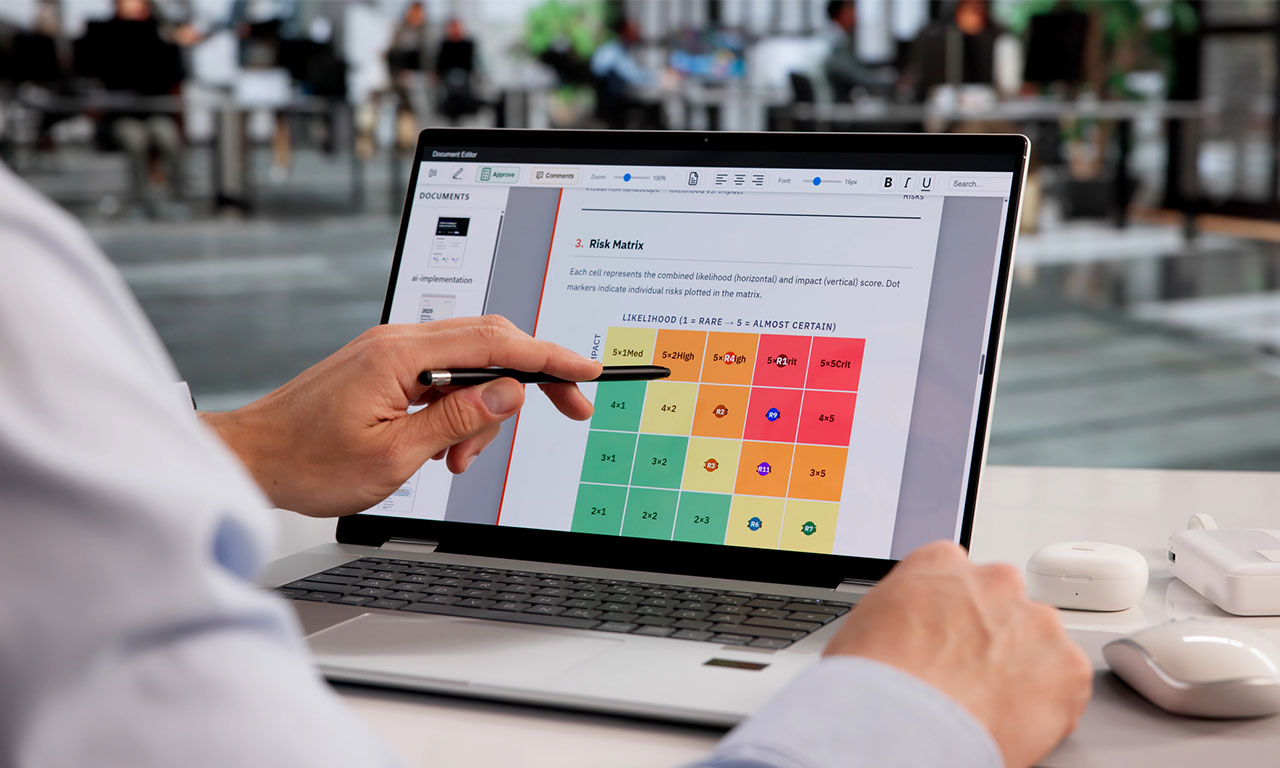
The result is a risk rating for each finding—driven by likelihood and impact—shown as a matrix (urgent, high, medium, low), paired with a remediation roadmap that then sequences the work to deliver the largest risk reduction per unit of effort.
How Modern Tooling Informs a Cybersecurity Risk Assessment
Tooling accelerates and sharpens a cybersecurity risk assessment without replacing expert analysis. Two Microsoft tools commonly used to ground findings are Microsoft Secure Score and Microsoft Defender for Business.
- Microsoft Secure Score aggregates posture signals across Microsoft 365 (identities, devices, apps, and data), highlighting misconfigurations and recommended improvements and assigning a numeric score. In an assessment, Secure Score provides:
- A prioritized list of recommended configuration changes.
- Visibility into which recommended actions offer the greatest opportunity to improve security posture.
- A measurable baseline to track improvement after remediation.
- Microsoft Defender for Business surfaces endpoint threats, suspicious activity, and alerts that indicate active or recent compromise attempts. In an assessment, Defender data helps:
- Identify detection gaps and recurring alert patterns.
- Provide concrete examples of risky behavior or compromised assets.
- Validate whether controls are functioning as intended.
When assessors combine these telemetry sources with configuration exports and interviews, recommendations move from theoretical to defensible: “here’s the alert history that shows this behavior” rather than “we think this might be risky.”
What Separates a Useful Assessment from a Generic Assessment
Many vendor pages describe risk assessments in broad terms. A practical, execution‑ready assessment includes:
- Concrete evidence: screenshots, Secure Score items, Defender alerts, and configuration exports that show the issue exists.
- Remediation steps with owners and estimates: not just “enable MFA” but “enable conditional access policy X for group Y; estimated 4–6 hours; owner: IT operations.”
- Business mapping: which customers, contracts, or compliance requirements are affected.
- Quick wins vs. strategic projects: a roadmap that balances immediate risk reduction with longer investments.
- Validation plan: clear metrics and remeasurement steps so leadership can see progress.
That level of detail turns an assessment into a plan you can execute without rescoping.
Typical Remediation Examples and Timelines
- Quick Wins (hours to days)
- Enforce MFA for admin accounts; close unused management ports; apply critical patches to a small set of servers.
- Near Term (weeks)
- Harden identity configuration with targeted policies; implement least privilege for key roles; tune detection rules.
- Strategic (months)
- Network segmentation, zero‑trust architecture changes, replacement of legacy systems, or a full EDR/SIEM rollout.
Each recommendation should include an estimated effort and the expected reduction in risk so leadership can budget and prioritize.
Turning Assessment Results into Ongoing Improvement
A cybersecurity risk assessment is most valuable when it becomes part of an operational cycle:
- Remediate urgent items first by focusing on fixes that reduce the most risk in the least amount of time.
- Update runbooks, change control, and monitor to ensure fixes persist.
- Remeasure Secure Score, track Defender alerts, and report progress to stakeholders.
- Schedule periodic reassessments. As risk changes as systems and threats evolve, periodic reviews keep the roadmap current.
Abel Solutions helps teams move from a one‑time assessment to a continuous posture improvement program that ties technical work to business outcomes.
Practical Inputs that Accelerate Workflow
To size an engagement and make the deliverable useful, assessors typically request:
- Inventory of critical systems and cloud subscriptions.
- List of business‑critical applications and the data they handle.
- Access to posture telemetry where available (for example, Microsoft Secure Score and Defender for Business exports or read‑only access).
- Names of technical owners and business stakeholders who can answer questions and validate impact.
- Any compliance deadlines or budget constraints that affect sequencing.
Providing these up front shortens discovery and lets the assessment focus on the highest‑value areas. Abel Solutions structures assessments to produce prioritized, evidence‑based recommendations that leadership can act on. The deliverable is more than a report: it’s a decision tool that shows expected risk reduction, implementation effort, and validation criteria so progress is measurable and defensible.
If your business is looking for a tailored scope and timeline for your environment, Abel Solutions will gather posture telemetry such as Microsoft Secure Score and Defender for Business, map findings to your critical processes, and deliver a prioritized remediation roadmap with owners and validation steps. Our cybersecurity risk assessment services are built around exactly this process, from scoping through validation.